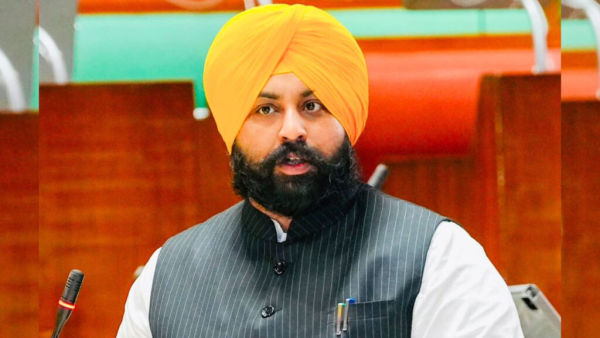

New Delhi: Claiming a historic transformation in education in the state, Punjab Education Minister Mr. Harjot Singh Bains today announced that Punjab has surpassed Kerala to top the NITI Aayog School Education Quality Index 2026. While in 2022, 8,000 schools lacked boundary walls and nearly 400,000 students were forced to study on mats, today 882 students from Punjab government schools have passed the NEET exam, and Punjab has become the first state in the country to introduce Artificial Intelligence as a core subject from grades 1 to 12. This is the transformation promised by the AAP-led Punjab government.
Big statement by Minister Harjot Singh Bains
Participating in the debate on the education resolution moved by MLA Prof. Jaswant Singh Gajjanmajra, School Education Minister Mr. Harjot Singh Bains reminded the poor condition of schools at the time of assuming office in July 2022.
Describing the results of a preliminary infrastructure survey, Mr. Bains said that more than 8,000 schools lacked boundary walls, 3,200 lacked usable bathrooms, and nearly 400,000 children were forced to sit on the floor. Textbooks reached schools in October-November, wasting several months of the academic year.
Challenging any government teacher to confirm this, he further said, “Now the same textbooks reach the district headquarters by February 15 and are distributed by March 31.”
Explaining his governance model, Mr. Bains said that he has personally visited over 2,000 government schools in every district of Punjab, including border schools, villages along the zero-line and remote areas.
He informed the House that the government’s flagship “Mission Samarth” has emerged as one of India’s largest basic education programs. Under its level-based teaching model, students are divided into groups based on their learning abilities, rather than grades, to ensure every child receives a thorough reading, writing, and math education.
Mr. Harjot Bains said, “When I visited schools in September-October 2022, I saw 8th-grade students who couldn’t even write simple sentences. Some couldn’t even do simple addition and subtraction. We identified these students and taught them from the 3rd-grade syllabus level. Today, they are making significant improvements.” He added that the program now covers approximately 1.2 million students and over 70,000 teachers annually.
Regarding the improvement in the performance of government school students, Mr. Harjot Bains informed the House that the number of students passing the NEET-UG exam from government schools in Punjab has increased from a mere 80 in 2021 to 882 in 2026. He said these results are a clear result of the Punjab Academic Coaching for Excellence (PACE) initiative.
He added, “The Punjab government’s education revolution has brought a new ray of hope for students.” Mr. Bains added that six students from government schools in Majitha and 17 in Dinanagar have passed the NEET exam. These are not statistics from private coaching institutes, but significant achievements of our government schools.
He made special mention of Harnoorpreet Kaur, a girl from a humble background, who secured All India Rank 3140 in her category, which reflects the capabilities of today’s government schools.
Taking aim at the opposition, he retorted, “Target me personally if you want. Why are you targeting government schools? False propaganda created by some negative-minded people has already driven people away from government schools.”
Responding to questions regarding the declining enrolment rate in government schools, Mr. Bains said that this trend was not limited to Punjab alone but has been observed across the country after Covid.
He further said, “Citing all-India data, he said that the number of students enrolled in government schools has decreased by 17.6 million. During COVID, enrollment in government schools actually increased. But after that, the numbers have decreased everywhere.”
Citing examples, Mr. Bains said that Bihar had 24.9 million students, which has declined to 21.3 million this year and is projected to further decline to 19.5 million this year. Similarly, in Uttar Pradesh, the number has declined from 44.4 million to 41.6 million, and is projected to reach 41 million this year. Furthermore, in Maharashtra, the number has declined from 23.2 million to 21.3 million.
Mr. Bains said, “He also cited the Indian government’s Apaar ID initiative, launched in 2023. ‘Now every student has a unique ID. Previously, a child would be enrolled in six schools but not studying in any of them. That’s why these figures are now correcting.’”
The education minister explained that infrastructure work worth ₹2,638 crore has been carried out in 19,125 government schools. This year, an additional ₹1,000 crore has been approved from the World Bank for further improvements.
Mr. Harjot Bains listed several “Schools of Eminence” that have been completely transformed. He cited the School of Eminence named after martyr Sukhdev Thapar in Ludhiana, which he said was once completely neglected. He said, “Today, ₹18 crore is being spent to make this school world-class. This year, 17 students from the school have also passed the NEET exam.”
He further said that the Punjab government led by Bhagwant Singh Mann is transforming government schools from a last resort to a first choice. We are not stopping here. We are setting higher goals every year.
Mr. Bains said, “Teachers no longer need to beg for funds to run government schools. We have provided the necessary funds for schools, unlike previous governments when teachers had to go begging for funds. The era of humiliation is over.”
Contact to : xlf550402@gmail.com
Copyright © boyuanhulian 2020 - 2023. All Right Reserved.